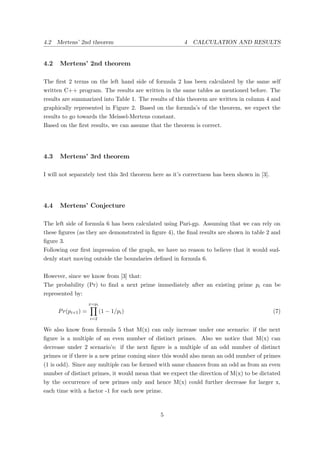
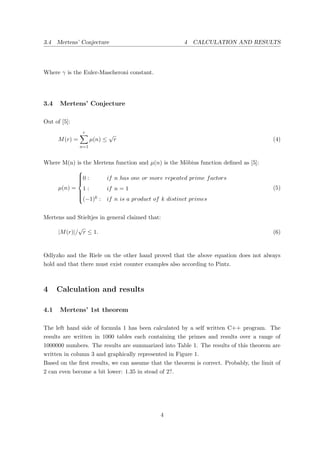
In mathematics, the Mertens conjecture is the statement that the Mertens function is bounded by . Although now disproven, it had been shown to imply the Riemann hypothesis. It was conjectured by Thomas Joannes Stieltjes, in an 1885 letter to Charles Hermite (reprinted in Stieltjes (1905)), and again in print by Franz Mertens (1897), and disproved by Andrew Odlyzko and Herman te Riele (1985). It is a striking example of a mathematical conjecture proven false despite a large amount of computational evidence in its favor.
Definition
In number theory, the Mertens function is defined as
where μ(k) is the Möbius function; the Mertens conjecture is that for all n > 1,
Disproof of the conjecture
Stieltjes claimed in 1885 to have proven a weaker result, namely that was bounded, but did not publish a proof. (In terms of , the Mertens conjecture is that .)
In 1985, Andrew Odlyzko and Herman te Riele proved the Mertens conjecture false using the Lenstra–Lenstra–Lovász lattice basis reduction algorithm:
- and
It was later shown that the first counterexample appears below but above 1016. The upper bound has since been lowered to or approximately and then again to . In 2024, Seungki Kim and Phong Nguyen lowered the bound to , but no explicit counterexample is known.
The law of the iterated logarithm states that if μ is replaced by a random sequence of 1s and −1s then the order of growth of the partial sum of the first n terms is (with probability 1) about √ n log log n, which suggests that the order of growth of m(n) might be somewhere around √log log n. The actual order of growth may be somewhat smaller; in the early 1990s Steve Gonek conjectured that the order of growth of m(n) was which was affirmed by Ng (2004), based on a heuristic argument, that assumed the Riemann hypothesis and certain conjectures about the averaged behavior of zeros of the Riemann zeta function.
In 1979, Cohen and Dress found the largest known value of for M(7766842813) = 50286, and in 2011, Kuznetsov found the largest known negative value (largest in the sense of absolute value) for M(11609864264058592345) = −1995900927. In 2016, Hurst computed M(n) for every n ≤ 1016 but did not find larger values of m(n).
In 2006, Kotnik and te Riele improved the upper bound and showed that there are infinitely many values of n for which m(n) > 1.2184, but without giving any specific value for such an n. In 2016, Hurst made further improvements by showing
- and
Connection to the Riemann hypothesis
The connection to the Riemann hypothesis is based on the Dirichlet series for the reciprocal of the Riemann zeta function,
valid in the region . We can rewrite this as a Stieltjes integral
and after integrating by parts, obtain the reciprocal of the zeta function as a Mellin transform
Using the Mellin inversion theorem we now can express M in terms of 1⁄ζ as
which is valid for 1 < σ < 2, and valid for 1⁄2 < σ < 2 on the Riemann hypothesis. From this, the Mellin transform integral must be convergent, and hence M(x) must be O(xe) for every exponent e greater than 1/2. From this it follows that
for all positive ε is equivalent to the Riemann hypothesis, which therefore would have followed from the stronger Mertens hypothesis, and follows from the hypothesis of Stieltjes that
References
Further reading
- Kotnik, Tadej; te Riele, Herman (2006). "The Mertens Conjecture Revisited". In Hess, Florian (ed.). Algorithmic number theory. 7th international symposium, ANTS-VII, Berlin, Germany, July 23--28, 2006. Proceedings. Lecture Notes in Computer Science. Vol. 4076. Berlin: Springer-Verlag. pp. 156–167. doi:10.1007/11792086_12. ISBN 3-540-36075-1. Zbl 1143.11345.
- Kotnik, T.; van de Lune, J. (2004). "On the order of the Mertens function" (PDF). Experimental Mathematics. 13 (4): 473–481. doi:10.1080/10586458.2004.10504556. S2CID 2093469. Archived from the original (PDF) on 2007-04-03.
- Mertens, F. (1897). "Über eine zahlentheoretische Funktion". Sitzungsberichte der Kaiserlichen Akademie der Wissenschaften, Mathematisch-Naturwissenschaftliche Klasse, Abteilung 2a. 106: 761–830.
- Odlyzko, A. M.; te Riele, H. J. J. (1985), "Disproof of the Mertens conjecture" (PDF), Journal für die reine und angewandte Mathematik, 1985 (357): 138–160, doi:10.1515/crll.1985.357.138, ISSN 0075-4102, MR 0783538, S2CID 13016831, Zbl 0544.10047
- Pintz, J. (1987). "An effective disproof of the Mertens conjecture" (PDF). Astérisque. 147–148: 325–333. Zbl 0623.10031.
- Sándor, József; Mitrinović, Dragoslav S.; Crstici, Borislav, eds. (2006), Handbook of number theory I, Dordrecht: Springer-Verlag, pp. 187–189, ISBN 1-4020-4215-9, Zbl 1151.11300
- Stieltjes, T. J. (1905), "Lettre a Hermite de 11 juillet 1885, Lettre #79", in Baillaud, B.; Bourget, H. (eds.), Correspondance d'Hermite et Stieltjes, Paris: Gauthier—Villars, pp. 160–164
- Weisstein, Eric W. "Mertens conjecture". MathWorld.
External links
- "A Prime Surprise (Mertens Conjecture)". Numberphile. January 23, 2020. Archived from the original on 2021-12-21 – via YouTube.
![[PDF] Disproof of the Mertens conjecture. Semantic Scholar](https://d3i71xaburhd42.cloudfront.net/3eb0d227a3495eed1650f3f81b50be4f247a22c4/250px/20-Figure2-1.png)
